- Wristlets Keychains
- Home
- Stallions
- Mares
- Sales
- Will I Miniatures Wish List
- Foaling Kits
- Just the facts
- Minis Breed Standard
- Gestation and Foaling a Miniature Mare
- Sick Foals
- Vaccinations and Worming
- Random Pictures at Will I
- Barneys Rescue Story
- Registered Basset Hounds
- LPLP PATN1 Perspective
- Hyperlipidemia
- The Pond
Will I Miniatures is sharing with you what we do to maintain the health and care of our horses. This isn't any advice or telling you how to breed or raise miniature horses. Consult your vet , as to changing feed schedule or emergencies please do not look to the internet for medical advice. The information you read her is what works for our facility and may not work for others, Will I Miniatures is only sharing information, and cannot be held liable for anything you read here, and the health care of your horses.
http://www.youtube.com/watch?v=YtnRlHwTf58
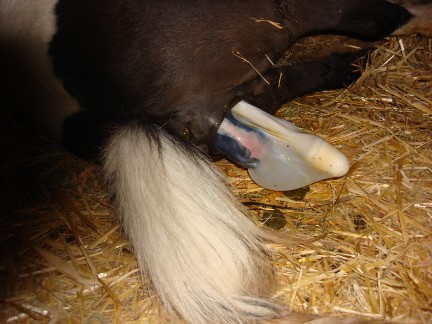
Miniature Mare gestation:
On average our miniature mares carry 326 days gestation. Some of our foals come as early as 300 days gestation, others carry 356.
We do find that mares tend to follow their dam's gestation length.
Typically, mares carry a little longer with their first foal.
Signs that your mini mare is preparing to foal:
- one to two weeks prior to foaling we notice our mares rolling more often.
- watch for any changes in her milk sac, heat and increase in size. Some mares begin "bagging up" weeks prior to delivery, others wait until the last minute.
- check the consistency of the milk too. 90% of the time the milk will change from a watery consistency to a thick syrupy texture, "colostrum" or mares first milk. This indicates the foal should come within 24 hours. Only a drop of milk is needed to rub between your fingers.
- very few of our mares "wax" like full size horses.
- check for softness around the tailset.
- check for swelling or elongation of the vulva.
- some mares may become nervous, restless and excitable.
- loose stool, lack of fecal balls - generally within 24 hours of foaling
These are all signs that the baby will be coming soon. Just be aware that maiden mares may not check my list. :-) Some maidens show no visible changes.
Stage One :
The first stage of labor is generally the
longest and may take from one to four hours.
The mare may act restless, circling her stall
or paddock. She may get up and down
frequently, pass small amounts of manure or
urine and act nervous. The mare may also
show some colic-like symptoms such as
looking at her sides, sweating along her neck
and flanks and showing signs of abdominal
discomfort. Mares may not exhibit all of
these symptoms but usually have a distinct
change of behavior during Stage One labor.
Stage Two :
This stage of labor begins when the mare's
"water" breaks and ends when the foal has
been delivered. The process takes
approximately 15 to 20 minutes to complete.
The water breaking is actually the rupture of
the chorioallantoic membrane, releasing
allantoic fluid. The membrane usually
ruptures before being pushed through the
cervix and the allantoic fluid will be
expelled in a gush. At this point, uterine
contractions will usually begin in earnest.
Generally at this point, the mare will lay
the time your mare is due to foal. Develop a
strategy of what to do if, for example, there
is no sign of a foal after the water has
broken. Make sure you have a foaling kit
with the basic essentials close by the foaling
stall along with the phone number of your
veterinarian and other people that may be of
assistance. Most mares foal with no trouble,
but understanding the birth process and what
should occur at each stage will ensure that
you will be able to enjoy the birth of your
foal without undue worry and stress.
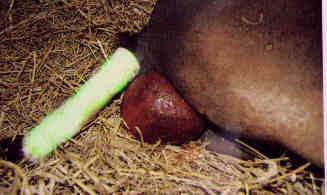
She may down if she has not already done so. Once the water has broken, the feet and head of the foal should start to emerge. The front feet should be delivered first with the soles pointing down in a normal delivery. One front foot is generally slightly ahead of the other and the muzzle of the foal will be at the level of its knees. The foal is encased in a thin, transparent, whitish membrane called the amniotic sack. Once the foal has been delivered, if the sack did not rupture during the labor, it should be torn open and pulled back from the foal's face and head to allow the foal to breathe. In contrast, if you see a velvety-red membrane emerging from the vulva, it is a sign that the placenta has detached prematurely without rupturing and it is an emergency situation commonly referred to as "red-bag". You should consult with your veterinarian prior to when your mare is due to foal to discuss what you should do if this situation occurs.
Stage Three :
Stage three is the expulsion of the placenta. It may take from one to three hours. If the
placenta has not been expelled after three
hours, it is considered retained and you
should contact your veterinarian.
Consult with your veterinarian about the
stages of labor and what to look for prior to
After your mare foals:
- Apply strong iodine or Novalsan to the foals umbilical cord after it is detached. Check with your vet about his/her suggestions. Current research indicates that most foals pick up bacteria from the ground rather than the old school of thought that bacteria enters through the navel stump. I still spray the navel with iodine.
- If you hear fluid in the babies lungs you may need to hold the foal up off of the ground by the hind legs and swing them gently back and forth. This will drain some of the fluid from their lungs.
- Pull on the mares nipple to make sure that she has colostrum to feed her foal.
- Check the foal for sucking reflex.
- The foal may nuzzle the milk sac but not drink. Make sure the foal gets hold of the nipple and stays there sucking for 30 seconds at a time - at least.
- Foals MUST drink the mares first milk. This colostrum is the only way the babies get protection and immunities. Without proper intake they may need a blood transfusion. The foal should begin nursing within two hours of birth. The sooner they begin to drink the more absorption of antibodies they receive. After 12 hours it may be too late. Your vet can do a simple blood test to see if the absorption has taken place. Nursemate is NOT adequate colostrum , they must have dam's milk. If dam refuses foal, you must milk dam and get some colostrum to get foal covered. An IGg snap test can be done to see if foal has gotten enough if not a transfusion is next step.
- After standing, the foal will begin to search for the teat and should nurse within two hours of being born . The foal may become weak if it does not eat in that two-hour time period. If the mare is moving about, inhibiting the foals ability to find the udder, a handler can halter her and hold her still. Some movement of the mare is normal and seems to be an important tool in teaching the foal to follow the mare. However, if the foal has been chasing the mare for more than an hour, intervention is warranted. It is important that all interactions with the mare and foal be done as quietly and calmly as possible. The veterinarian should be contacted if the foal does not nurse within the first two hours.
- The closer to 300 days gestation they foal, the closer you need to watch the baby for standing to drink milk. They may be weaker and unable to drink sufficient colostrum. So you must milk mare and give colostrum , if foal isn't nursing.
- If the mare is uncomfortable ask your vet what type of medication and dosage she would need. Some mares that are uncomfortable will not stand still for the foal to nurse.
- I also worm my mares within 12 hours to help prevent scours in foals.
- Sucking is average 20 minutes post foaling
- Time to standing on average is 57 minutes, not all foals are the same .
- Time to nursing average is 30 mins to within 2 hours if I know something is wrong, as with all my miniatures, I use , IGg then milk mare for some more and give to foal via syringe if, you have a foal wondering and not acting normal you could have a (dummy foal). The Neonatal Maladjustment Syndrome. Foals suffering from this syndrome behave abnormally for a number of reasons. One of the most common is the lack of oxygen due to the premature rupturing of the umbilical cord. It is often due to dystocia, septicemia or low glucose levels.
A Dummy Foal with mild symptoms will lack the foal suckling response and may be disoriented and irritable. It may wander aimlessly around the stall, not appearing to know where it is or what it should be doing.
One with more severe symptoms may have seizures or even become comatose. In either case, treatment should be started immediately. Waiting and expecting it to improve without treatment will probably result in the loss of the foal. If you suspect that your foal has this condition, call your Veterinarian immediately. The Madigan squeeze works wonders ! .
Many of these neonatal maladjusted foals will return to normal within a few days with farm-administered therapy. This often includes giving the foal glucose, oxygen and oral or intravenous nutritional support if needed.
- Body Temp first 4 days is 99-102f
- Heart rate average first 5 minutes is 70bpm
- First urination 8.5 hours after birth , colts usually urinate earlier than fillies
- Meconium (first stool) within 24 hours , however I always administer an enema I don't wait for any issues to arise, it won't hurt them to do it.
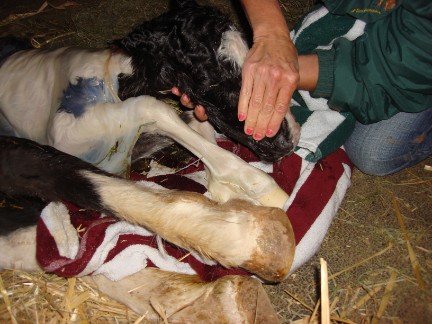
As with all my foals, I always run my hands down nostril to flush out any fluid.
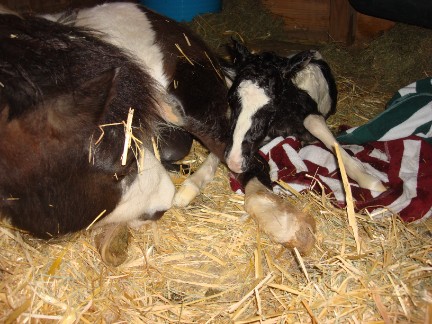
As one of my rules I try not to interfere with the foaling process unless I see something is not going the way it should. Several things can go wrong in foaling Miniature horse's.
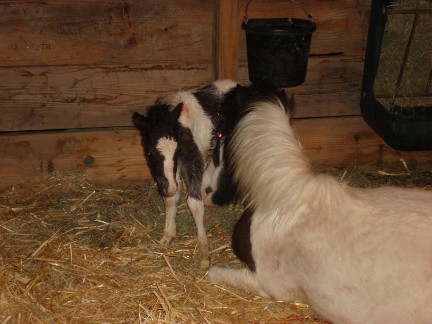
Red Bag Deliveries
Red bag deliveries, or premature placental separations, are frightening, even after you've seen several. The foal is in immediate threat of suffocation. Unless someone is standing by, ready and knowledgeable enough to assist, its young life will end in the next few minutes.
The mare herself is in no particular danger, unless the foal is improperly positioned. Usually, the foal, placenta and all, will be delivered normally. The foal, trapped within the thick sack that it is unable to break, will perish. But if you know how to assist, its life can usually be saved.
The most important thing to remember in a red bag delivery is that there is not a minute to spare. The placenta, which has been supplying the foal with oxygen throughout its gestation, is no longer doing so. The foal will soon start trying to breathe, but it will inhale only fluids, not air. It must be delivered quickly if it is to have a chance at survival.
One of the most difficult things about a red bag delivery is breaking open the placenta. It is tough and slippery, and almost impossible to tear with your bare hands. A knife would do it, but could be dangerous to mare or foal should it slip, or should it be dropped in the bedding when you have your hands full of foal. I have found that one of the best tools for cutting the placenta is inexpensive and safe. A heavy pair of scissors will cut them. You want a sharp point. Stick several of these in your foaling kit. As soon as you see the red bag, even before it begins to emerge, use one to slice the bag open. Immediately reach into the mare and feel for the water bag. Cut it open, too. Then, drop the stick and reach in for the foal.
Do you feel two hooves and a nose? If so, grasp the front feet and pull in time with the mare's contractions. You must get the foal out quickly if you're going to save it, but don't injure your mare in the process. Once you get the front feet out a few inches, stagger them so that one is ahead of the other and continue to pull. Remember to always pull the foal down towards the mare's hocks, not straight out. Do not wait for the mare to push the foal out by herself. Remember that the foal is not getting oxygen!
As soon as you have gotten the body delivered, and the foal's chest is no longer constricted by the birth canal, make sure it starts to breathe. You will likely hear gurgling sounds from the fluid it has inhaled. Gently squeeze some of the moisture out by holding the bridge of the nose between thumb and forefinger and sliding your hand down towards its nostrils. If you have a towel handy, this will help as well. Stimulate the baby by vigorously rubbing it and by scratching the ticklish spot in the middle of its back. It should begin to try to raise its head. If the foal is still not breathing well, or still gurgling, now is a good time to call the vet. If you have someone with you, have him or her do it so you can continue to assist the foal. You may have to pick it up by its back feet and let some of the fluid drain from its lungs.
Indications of Disease or problem with foal
A healthy foal is bright, alert, and full of energy. It will nurse at least once every hour. It is curious of its surroundings and between nursing and playing, will sleep soundly .
The following are signs of illness or disease in a foal and are indicators that veterinary attention should be obtained.
• The foal does not stand within one hour of birth or nurse within two hours of birth.
• The foal does not search for the udder or bond with the mare.
• Straining to urinate or defecate.
• Depression or loss of appetite (the foal is not seen nursing or the mares udder is constantly full).
• Frequent rolling from side to side or laying on its back when sleeping.
• Signs of colic.
• Lameness.
• Swelling of, or discharge from the umbilicus.
• Urinating out of the umbilicus.
• Swelling in the inguinal (groin) area.
• Fever (see Normal Physical Parameters, Appendix A).
• Failure to gain weight.
• Coughing.
• Milk coming from its nose .
• Difficulty breathing or abnormal respiratory noise .
• Squinting or holding its eyes closed.
Meconium is the fecal material that forms while the foal is still in the uterus. It has a black, tarry appearance. The meconium can become impacted in the large colon or rectum. The most common sign of a meconium impaction is the foal straining to defecate, but signs of colic may be seen in the more severe cases. Veterinary care should be sought any time a foal is seen straining to defecate.
Many breeders routinely administer an enema to a newborn foal to prevent meconium impaction. Over-the-counter pediatric enemas work well in Miniature horse foals. The foal should be restrained and the enema inserted gently to minimize the chance of injury to the rectum. Passage of softer, brown feces signals that all the meconium has passed and the foal is passing fecal material produced since birth (milk feces).
The foal should be observed for urination during the first two to three days. In rare instances, a foal's bladder can rupture during the birthing process. This is more common in male foals; the narrow diameter of their urethra allows a greater pressure buildup in the bladder. The best time to watch for urination is after the foal gets up from a nap. It will usually nurse, then urinate shortly after nursing. Signs of a ruptured bladder are straining to urinate, colic, bloated abdomen, weakness, and loss of appetite.
- Wristlets Keychains
- Home
- Stallions
- Mares
- Sales
- Will I Miniatures Wish List
- Foaling Kits
- Just the facts
- Minis Breed Standard
- Gestation and Foaling a Miniature Mare
- Sick Foals
- Vaccinations and Worming
- Random Pictures at Will I
- Barneys Rescue Story
- Registered Basset Hounds
- LPLP PATN1 Perspective
- Hyperlipidemia
- The Pond